

I am very bullish on AI as a technology. But that does not mean I am bullish on all AI-related stocks, because valuations matter.
Ulf Huse recently wrote a lovely report on AI capex, who funds it, and how they fund it. It is required reading for anyone invested in anything semiconductor-related.


Sam Altman recently said something similar, paraphrased: “The economy is taking longer than I thought to adjust to AI. Existing processes and workflows are sticky.”
There is a lot of latent demand for AI. I run into usage limits on Codex daily, while there are still plenty of people catching up with what Codex and other agent harnesses can actually do.
We still need more versions of Palantir’s business model, going around selling and integrating AI into companies run by boomers who think AI is just something you use to answer trivia questions.
I am bullish on AI—the technology.
But one of the biggest risks I see to the capex cycle is whether Anthropic and OpenAI can establish durable moats.
I do think they have some stickiness. I don’t see myself moving away from Codex anytime soon, particularly now that the new ChatGPT desktop app has replaced my use of Codex in the terminal.
But it’s still early days. If I could get the same compute usage, with a similar harness, for less money, I might move. I’m an early adopter, and my workflows and wiki are already built out in Obsidian, so switching to another harness wouldn’t be particularly difficult.
If that is true for enough users, OpenAI and Anthropic may have to defend their market share by competing on price, potentially compressing margins even as usage grows.
Enterprise customers would probably be much slower to move, given the costs of integrating AI into existing workflows.
My main counterargument to the bearish thesis Huse proposes is that I still believe there is an enormous amount of money that has yet to flow from companies employing white-collar workers towards AI providers like OpenAI and Anthropic.
Many companies have yet to deeply integrate AI into their businesses. They are still using it relatively superficially, but that transition is underway.
And as they begin to redesign their workflows around AI, rather than simply using it as a chatbot, I think the amount they are willing to spend could increase significantly.
On top of this, there will be entirely new applications—video generation, image generation, world models, and things we haven’t even thought of yet—that will create demand for even more compute.
Of course, the risk is that compute supply grows even faster than demand, and that much of the economic value ends up with customers rather than the companies building the infrastructure. AI can be an incredible technology without every company in its supply chain earning an attractive return on capital.
That being said, I highly appreciate views like Huse’s, because I don’t believe in a blanket “bear” or “bull” argument for AI.
I believe some AI-related stocks are egregiously overvalued, and others are not.
There will be constant rotation as the market moves quickly to take profits, reassess expectations, and discover yet another second- or third-order effect that AI is causing.
Being right about AI as a technology doesn’t necessarily mean being right about the stocks.
Anthropic’s S-1: A potential $100 billion IPO to fund its staggering commitments
Anthropic’s S-1 has provided the market with some much-needed clarity.
This business is incredible. I honestly think it gets even more incredible from here, as both Anthropic and OpenAI have realised they can use their own internal models to expand into almost every business and industry at breakneck speed.
They have an opportunity to get far ahead of their competitors—and, perhaps more importantly, far ahead of China.
Anthropic is reportedly looking to raise as much as $100 billion in its IPO, although that figure has not yet been confirmed in its S-1.
And once you look at how much money Anthropic has committed to spending over the coming years, you can understand why it might want that much capital.
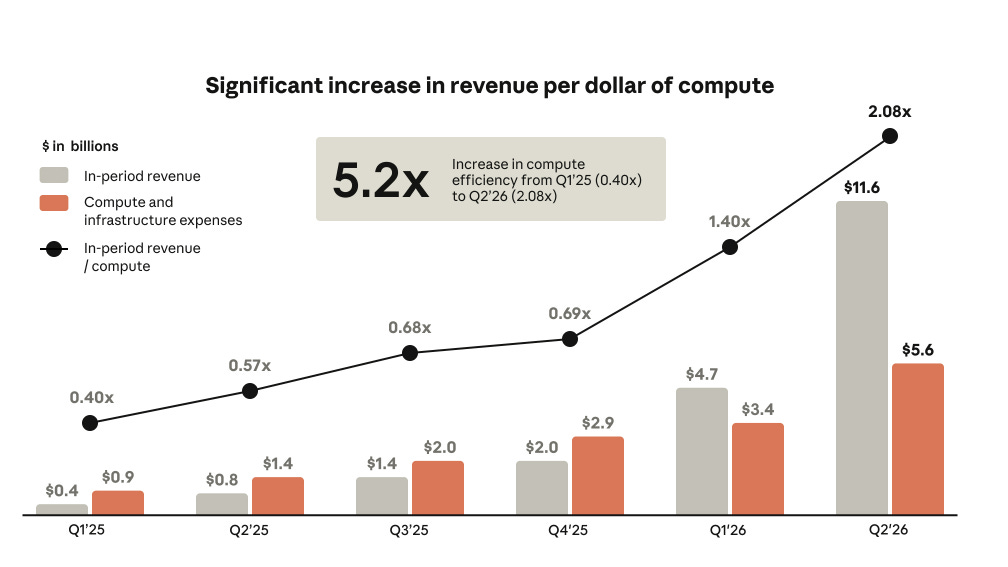
One small step for AI, one giant leap for mankind.
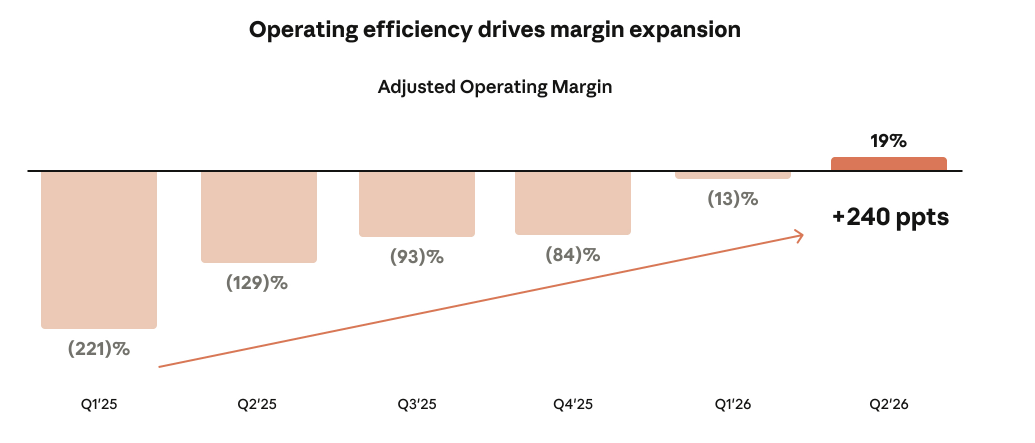
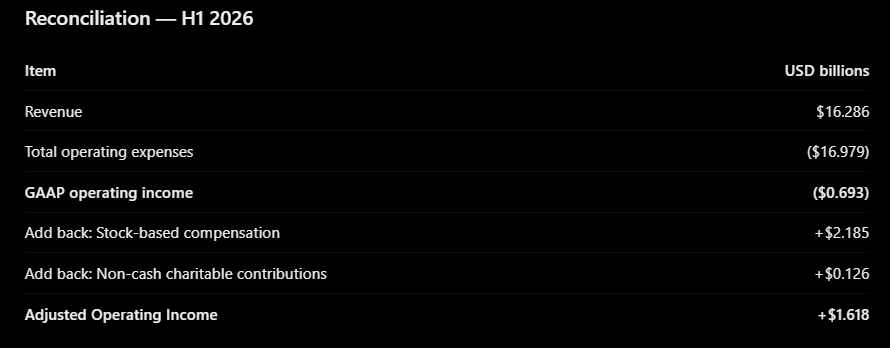
It’s worth understanding what is being “adjusted” here, because companies often add back very real costs, like stock-based compensation, to flatter their earnings.
The reconciliation is shown below.
I honestly expected them to be adding back a lot more irrelevant items, but this looks fairly standard: stock-based compensation, non-cash charitable contributions and a litigation settlement in 2025.
Stock-based compensation is still a real cost, of course. It amounted to $2.2 billion in the first half of 2026, so it’s hardly negligible.
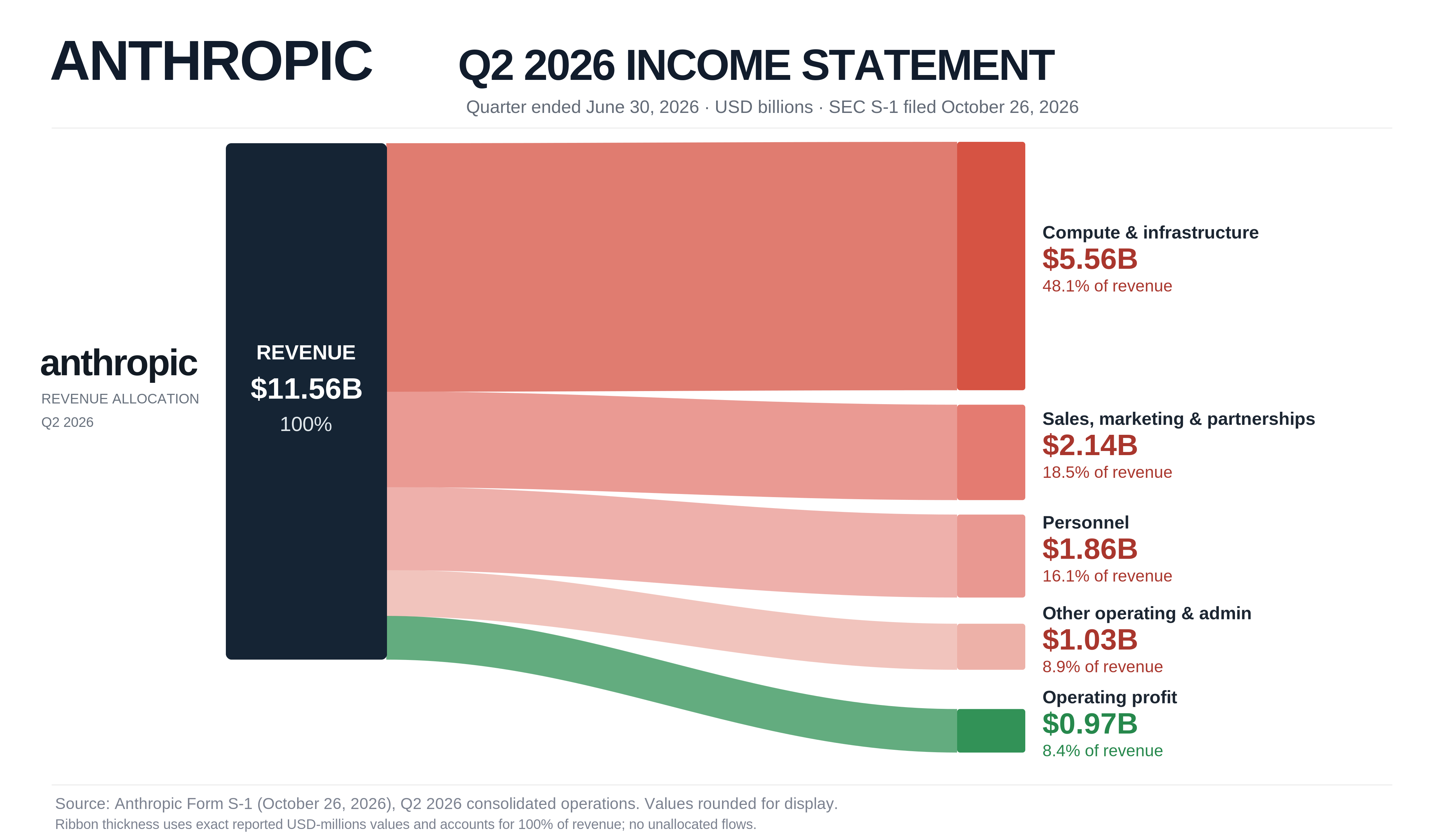
But what’s particularly impressive is that Anthropic actually reported an operating profit of $974 million in Q2 2026, even without adjusting for stock-based compensation.
The company still made an operating loss of $693 million across the first half of the year, but the trend is remarkable.
Operating expenses
The biggest expense for Anthropic is compute and infrastructure.
In simple terms, Anthropic needs an enormous amount of computing power to train its models and to serve the people using Claude.
It gets much of that computing power from companies like Amazon, Google and Microsoft, which build and operate the infrastructure and charge Anthropic for using it.
Neither Anthropic nor OpenAI has given us a reliable breakdown of how much compute is used for training versus inference. I’ve seen estimates suggesting something around 50/50, but I’d treat that as a rough assumption.
What’s particularly interesting is that Anthropic is changing how it gets its compute.
Rather than relying entirely on cloud providers, it’s increasingly arranging for dedicated equipment and data centre capacity, sometimes leasing the chips directly and paying other companies to operate the infrastructure.
The idea is that this could be cheaper in the long run, because Anthropic has more control over the infrastructure and doesn’t necessarily have to pay the same bundled price charged by cloud providers.
But the trade-off is that Anthropic takes on much larger financial commitments, sometimes having to pay for infrastructure before it is even operational.
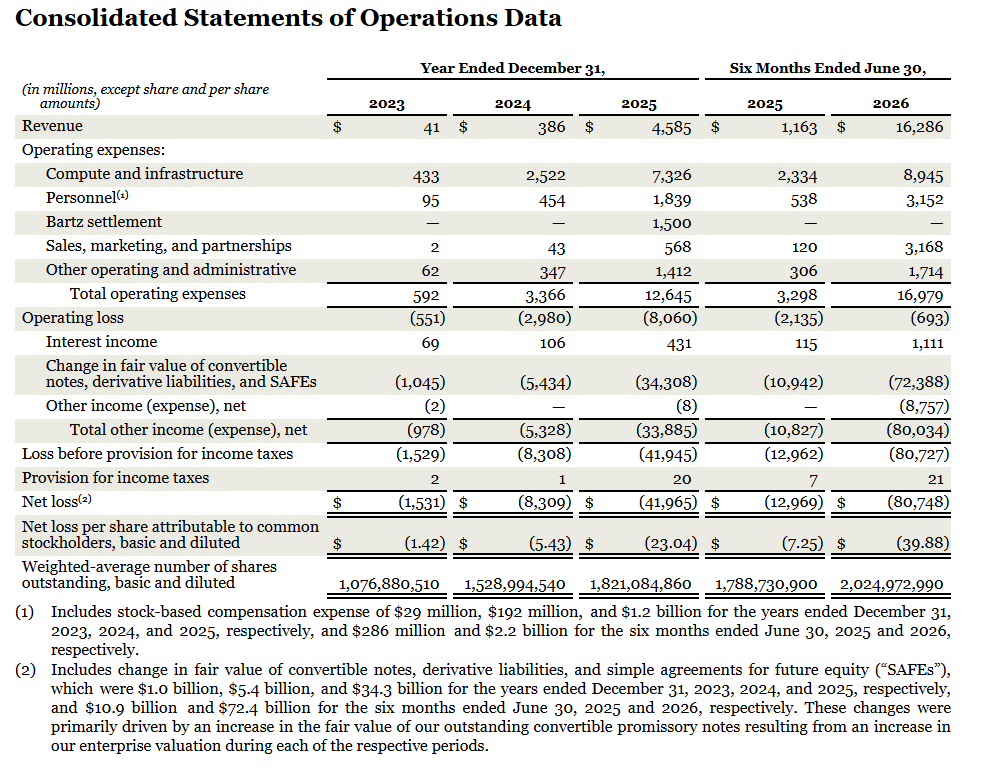
Little bit easier to visualize it like this.
Future commitments
Now, this is where things get really interesting.
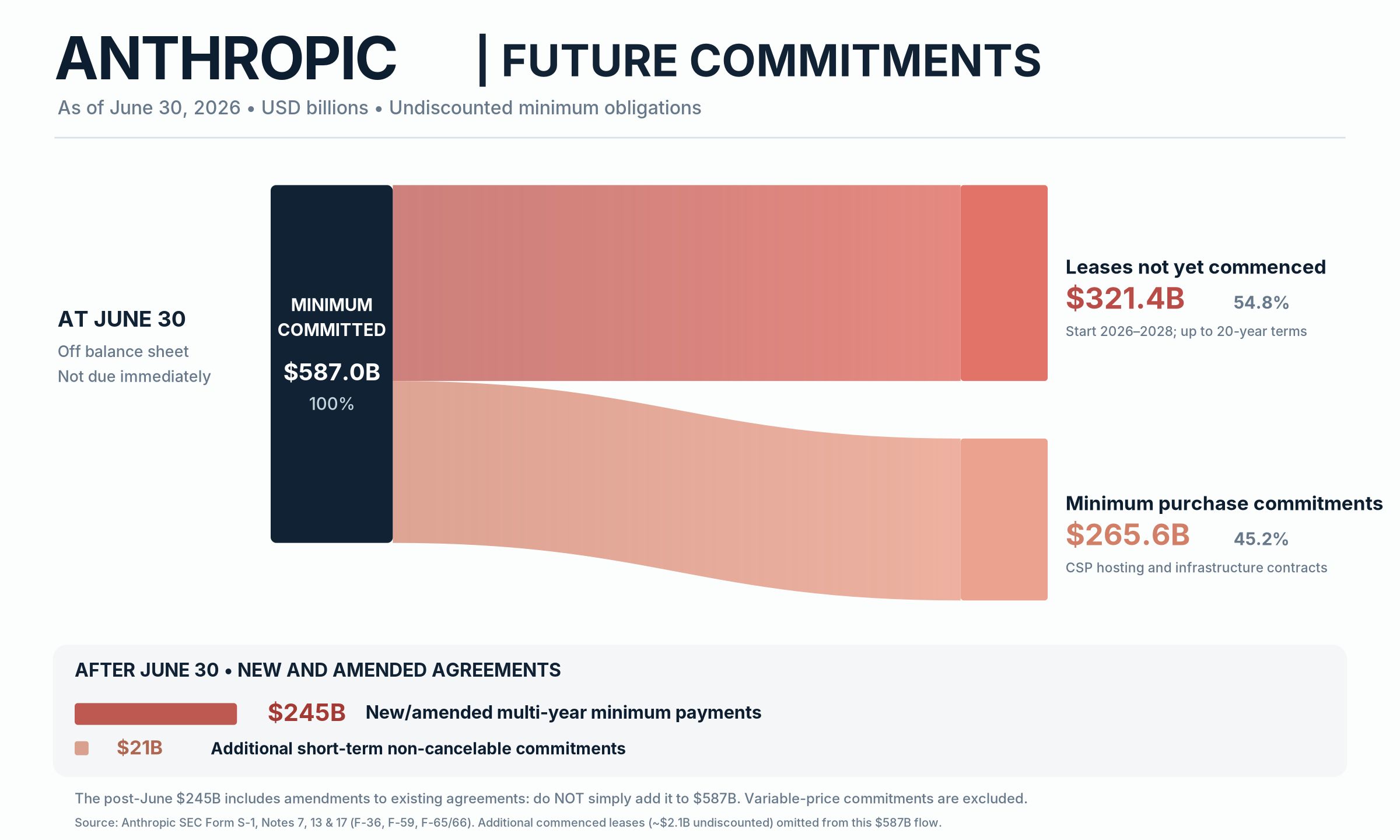
Anthropic’s future compute commitments are a staggering $587 billion.
That’s made up of approximately $266 billion in purchase commitments and $321 billion in leases that had not yet begun. They’re spread over many years, with some contracts extending as far as 20 years.
And there have been further agreements since then, including another $245 billion in minimum payments relating to new and amended contracts. We can’t simply add all of these figures together, as some of the amendments may overlap with existing commitments.
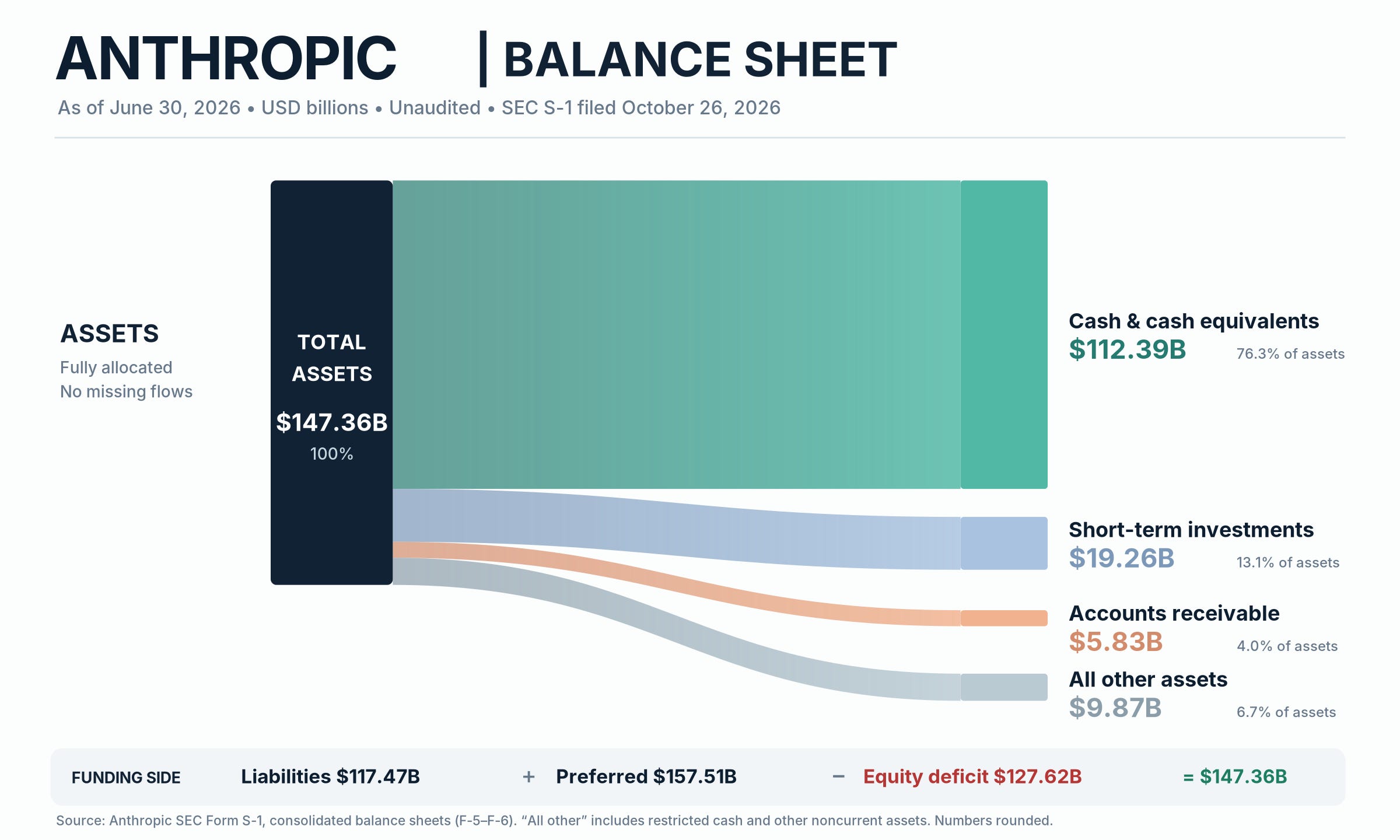
To put these numbers into perspective, Anthropic had roughly $132 billion in cash and short-term investments at the end of June.
If it raises another $100 billion in the IPO, that’s around $232 billion in available capital, before subsequent cash flows and other uses of the money.
Now, my initial thought was that this should be enough to cover much of the next five years, with Anthropic eventually funding the remaining commitments through its own profits.
And that might still happen.
But there’s an important problem with looking at it that way.
We don’t know exactly how much of these commitments must be paid in each of the coming years, and the company is still signing new agreements. Anthropic itself only says it has sufficient resources to cover at least the next 12 months.
This brings me back to Ulf Huse’s report, which I mentioned earlier.
Huse estimates that the AI industry is on track to spend roughly $1.75 trillion on infrastructure in 2027 alone. He estimates that this would require something like $700 billion in additional annual revenue to earn a reasonable return on the investment.
And his question, essentially, is: Who is going to pay for all of this?
The hyperscalers have enormous existing businesses that can help finance their investments. But many of the companies building AI data centres are borrowing money or raising equity to do so, with the expectation that companies like Anthropic and OpenAI will pay them back over time.
Anthropic’s commitments are evidence that this demand exists. But they also show just how much future revenue the industry is counting on.
What if that revenue takes longer to arrive than expected?
Or what if compute supply grows so quickly that prices start falling before these expensive data centres have earned an adequate return?
That’s the risk Huse is highlighting. Its a very important risk that is discussed continously on X in various forms- GPU rental prices, NeoClouds, etc. You see “Jevons paradox” thrown around a lot- the fact that as more compute becomes available, more is used- which is true when I look at my own usage.
And interestingly, cheaper compute could eventually be very good for Anthropic. Its biggest expense would become cheaper, potentially allowing it to earn much higher margins.
The catch is that Anthropic has already committed to paying for enormous amounts of compute under existing contracts. If prices fall sharply, it could find itself paying more for older capacity than competitors pay for newer infrastructure.
On the positive side, the economics are already improving dramatically.
In the first half of 2025, Anthropic spent roughly $2 on compute for every $1 of revenue it generated.
In the first half of 2026, that figure had fallen to just $0.55.
Huge progression…
But the company has an enormous amount of additional compute coming online, which means the associated expenses will continue to increase. Anthropic itself expects its infrastructure investments to consume substantial cash going forward.
So the question is whether revenue keeps growing faster than those costs.
I think it can. There is still an enormous amount of demand for AI that has yet to materialise, particularly from enterprises that are only beginning to integrate AI properly into their businesses.
But Huse makes an important point: even if AI demand continues to explode, it doesn’t necessarily mean that everyone financing the infrastructure will earn attractive returns.
It’s too early to tell, and I am honestly more focused on the areas that Anthropic and OpenAI have chosen to disrupt- like biology.
We don’t know how much disruption AI can cause- they are not just chat bots or artificial girlfriends. They are solving real problems we never throught we’d see get solved.
Taking profit
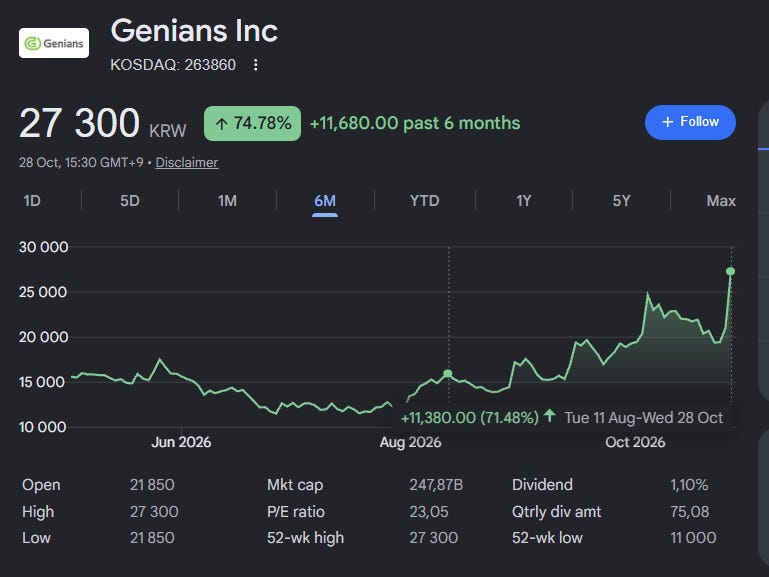
I mentioned Genians multiple times in the subscriber chat. I’ve fully sold out now. Might be too early, but the market is currently running quite ahead of the numbers- which I think will be exceptional.
I cannot give you advice whether to buy or sell. In the past I have made the mistake of selling out too early, many times. Do with that what you will.
On who carries the risk if that revenue arrives late: for the TPU racks, part of it sits with Broadcom. Its filings show it backstops the financial partners that took on the rack leases, covering the gap between 85% of what's still owed and what the racks would sell for (up to about $29 billion), and 72.5% on the newer vehicle in its October 27 8-K (up to about $43 billion).
On timing, the S-1 does give the windows for the big cloud minimums: Google at least $114.5 billion from April 2026 to July 2033, Amazon $110.0 billion from May 2026 to April 2036, and Microsoft $44.9 billion from November 2026 to May 2033. The Google and Amazon ones are owed regardless of actual usage, with a true-up if spend falls short.
I work at Equibles and put the S-1 next to the partners' filings: https://equibles.com/research/anthropics-s-1-checked-against-amazon-google-microsoft-and-broadcom-filings