

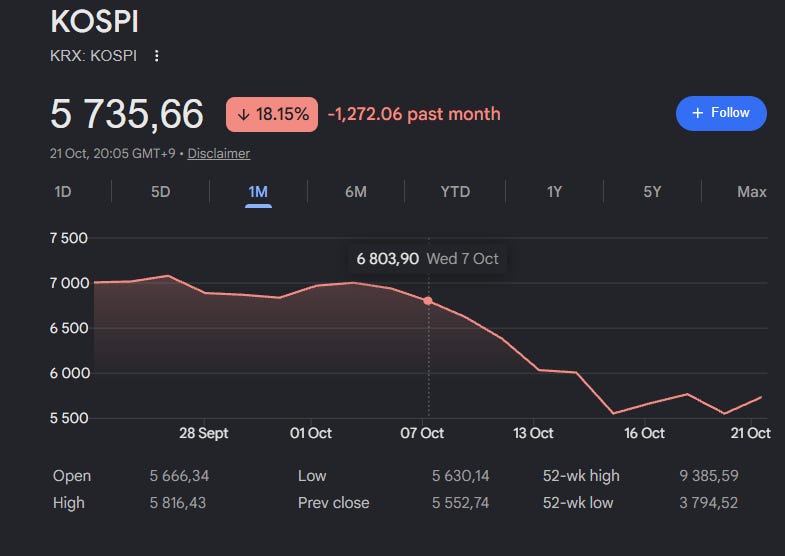
Semis Sell-off
Attribute the sell-off to what you will, if you buy companies at decently undervalued prices it shouldn’t worry you that much.
Our top Korea pick Worldex fell along with the index, matching its decline almost exactly- at -17% over the month. At this price, it’s ridiculously undervalued, I expect it to rebound.
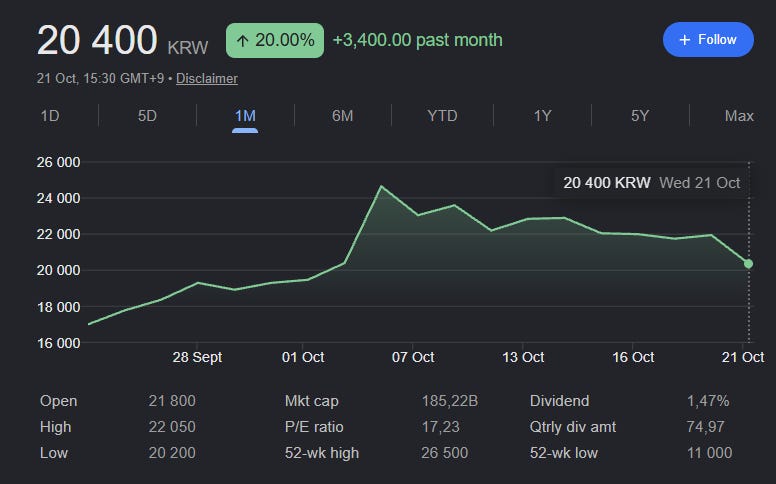
Our other Korean Top Pick increase by 20% over the same month, as Cybersecurity fears become more apparent, and as the market recognises those who benefit.
I see the semis sell-off as a natural correction.
The buildout is real, and not stopping but at the same time valuations must always be respected, and I feel like the market sees good news and thinks “ok stocks must go up on this”, but it’s not taking into account what those prices already imply about how much growth is needed to support these valuations.
If this doesn’t make sense to you, to put it simply, the market already expects so many of these names to grow at an insanely fast pace, and its reflected in the prices of stocks.
Deepseek 2.0
To keep this simple: DeepSeek has released software that potentially makes it much cheaper for almost anyone with powerful GPUs to run an AI business.


Okay so I didn't understand how DeepSeek benefits from this, or what their incentive here was because then how do they fund the training of their next model? Through more equity?
but founder Liang Wenfeng said its this:
DeepSeek believes it can still make money because it can run its models more cheaply than competitors (these 'inference providers' I guess?)
In a reported May 20, 2026 investor meeting, founder Liang Wenfeng made three arguments:
1- DeepSeek can operate its own models at exceptionally low costs. He argued that even with free access to its models, competitors would struggle to match DeepSeek's production economics.
2- DeepSeek can therefore charge for its API without needing to monopolize the technology. Many customers will still find it easier or cheaper to pay DeepSeek than to run the model themselves.
3- DeepSeek doesn't need to maximize profits. Liang reportedly described targeting roughly a ten-month payback on inference hardware rather than extracting the highest possible price from customers.
He explicitly argued that third-party deployment would struggle to compete with DeepSeek's costs, so open-sourcing would not necessarily undermine API revenue.
I don't know about DeepSeek's strategy-because Western Labs will probably price-gouge temporarily (until compeition just brings inference cost down) to fund the training of the NEXT BEST model while deepseek is still raising from equity?
What happens to the future models?
It seems like we just get super smart frontier models coming from Anthropic and OpenAI that do all sorts of ground-breaking research (which will probably be used internally by the labs for their own benefit), and DeepSeek dominates for dumber inference tasks.
Where we are in the buildout
NVIDIA identifies six critical manufacturing partners.
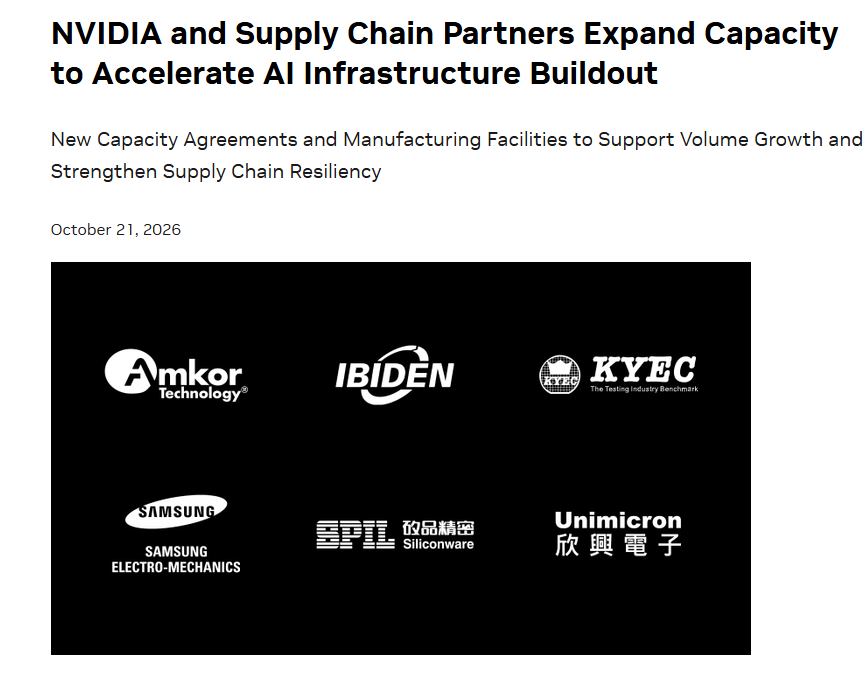
Announced today:
Substrate agreements with IBIDEN, Samsung Electro-Mechanics and Unimicron Technology Corporation will, in aggregate, drive a 2.5x increase in capacity over the next three years.
Amkor plans to increase its advanced packaging capacity by more than 300% by the end of 2028.
KYEC will build new facilities in the U.S., supported by a $1.1 billion capacity reservation advance from NVIDIA.
SPIL is targeting to increase its optical-engine capacity for co-packaged optics by 15x by mid-2027, with aims for another doubling by the end of 2028.
Top Testing bottleneck names to watch:
KYEC (King Yuan Electronics) 2449.TW
KYEC is a testing company that specializes in wafer testing, final testing and burn-in services for advanced chips, including AI accelerators.
NVIDIA has committed a US$1.1 billion advance against future testing services to support KYEC's US capacity expansion, with high-volume production targeted for April 2027.
It’s currently sitting at a 2027 forward PE of 19.4
ASE Technology Holding (3711.TW)
Through its subsidiary SPIL, ASE is one of the world's largest outsourced semiconductor packaging and testing companies.
NVIDIA has announced plans with SPIL to expand co-packaged optics (CPO) capacity by 15× by mid-2027, potentially reaching 30× current capacity by the end of 2028. This is a massive committment.
They currently trade at a 2027 forward PE of 23.6
I do not own either of these names, earnings are estimated to growth more than 137% for KYEC from 2026 to 2028, and more than 100% for ASE Technology.